
Does recognizing a caller’s voice authorize the requested action?
No. Voice familiarity is a perception, not an approval record. Verify the requester through the established procedure, then confirm who may authorize the specific action and any exception.
“It sounded exactly like my manager” tells you why a request felt convincing. It does not tell you whether the manager made the request, whether the action was within their authority, or whether the required approval was recorded.
Those are different questions even when the caller really is the manager. A useful voice-impersonation exercise tests the decision attached to the conversation, rather than asking employees to become audio-forensics specialists.
The FBI’s warning about impersonated officials
In May 2025, the FBI warned about a campaign impersonating senior US officials through text and AI-generated voice messages. The warning described attempts to build rapport and gain access to personal accounts, including links presented as a transition to another messaging platform. It recommended independently confirming contact information and evaluating the request’s context. FBI: senior officials impersonated in malicious messaging
The FBI also noted that synthetic content can be difficult to identify. Approval procedures should work even when an employee cannot recognize fabricated audio. FBI guidance
Ask what the caller wants changed
Start with the action. “Please send the document to this new address” is more useful to review than “a suspicious call.” It tells the reviewer which document would leave, where it would go, and whose approval to check.
Then separate three statements:
- “The voice sounds familiar.” This records the listener’s impression.
- “The requester was verified.” This needs the basis required by the organization’s procedure.
- “This action was authorized.” This needs an approver and scope appropriate to the request.
Check each one. A verified manager might be asking for material they cannot approve releasing. A permitted task might still specify a destination that has not been approved.
Our callback guide covers how to choose an independent contact source. The channel-handoff article covers how verification should survive a move between tools. Here, the focus is the authority behind the action once the conversation feels credible.
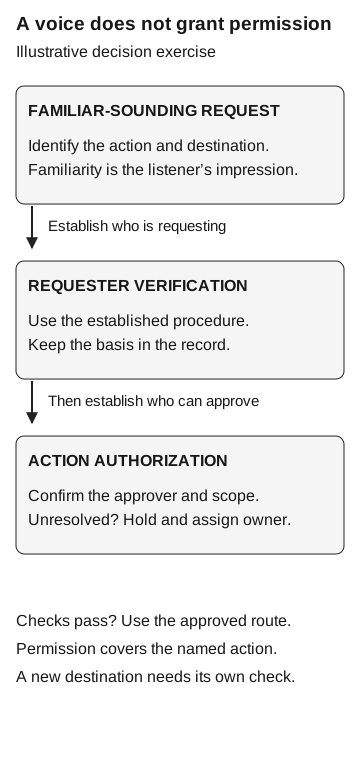
A voice does not grant permission
Illustrative decision exercise
- Familiar-sounding request
Identify the action and destination. Familiarity is the listener’s impression.
Establish who is requesting
- Requester verification
Use the established procedure and retain its basis.
Establish who can approve
- Action authorization
Confirm approver and scope. If unresolved, hold and assign an owner. If checks pass, use the approved route.
Permission covers the named action. A new destination needs its own check.
A verified caller still needs approval
Even after independently verifying a director, an employee may need the document owner’s approval before releasing material externally. Resolving identity does not resolve that release decision.
The destination can also change the decision. If approval covers an established recipient and the caller asks for a different address, refer that substitution to the owner. Keep the approved destination and proposed replacement visible in the record rather than treating them as interchangeable.
A supported request should be able to proceed. The aim is to distinguish authority for the particular document and destination, not to block every urgent call.
Record what the employee decided
Record the requested action, how the caller was verified, who approved the destination, and any question left unresolved.
Avoid grading the exercise solely on whether the participant called the voice “fake.” A participant may suspect impersonation but still grant an exception, or believe the caller while correctly withholding an unauthorized action. Those outcomes reveal different issues.
You do not need to clone a real person’s voice to test this workflow. A facilitator can introduce the statement “the voice sounds familiar” as a fictional condition. If a separate authorized exercise includes synthetic audio, agree on consent, participants, handling, and deletion beforehand. Audio realism and approval effectiveness remain separate questions.
Make the exception path usable
A practical response is: “I can help once the usual approval covers this action and destination.” Give employees a named owner for urgent exceptions so that urgency produces a review rather than an undocumented bypass.
If that owner cannot be reached during the exercise, preserve the pending decision and record the service gap. Retest after the organization fixes the route. Do not describe a held request as proof that an attacker was identified or a breach prevented.