
Connect the invoice to the actual supplier relationship, approved purchase or contract, billed period, and responsible business owner. An invoice is a demand for payment; its appearance alone does not establish that your organization owes it.
Recognizing the supplier or the type of service on an invoice does not confirm that your company ordered it. Even an urgent renewal needs a connection to the purchase it claims to bill.
Before reviewing how to pay, establish what makes this amount payable. Accounts payable needs the purchase or contract record and a business owner who can explain the charge.
A convincing invoice can bill for something you never ordered
The US Federal Trade Commission describes fake invoices for products or services a business did not order. It also describes deceptive directory listings: a caller asks to confirm information, then a bill follows and the earlier conversation is used to pressure the recipient. These are documented scam patterns, not evidence that an unfamiliar invoice is necessarily fraudulent. FTC: scams targeting small businesses
The same guidance recommends clear procedures for approving purchases and checking invoices. The checks below help route a mismatch; they do not determine whether a disputed contract is legally enforceable. Procurement or legal counsel should resolve that question through the organization’s actual process.
This differs from our supplier bank-detail review. There, the organization may owe a genuine supplier and must verify a changed payment destination. Here, the first unresolved issue is whether this claimed charge belongs to an authorized purchase at all. Both reviews can be necessary for the same invoice.
Match the invoice to the purchase
An invoice requests payment for specified goods, services, or other charges. A purchase order records a purchase instruction under the buyer’s process. A contract can establish continuing services and terms without a separate purchase order for every invoice. None of those labels makes a document authentic by itself.
Ask the responsible owner which records establish the charge in your process. For a subscription, that might be the executed agreement, the service account, and the current billing period. For a goods order, it might include the authorized order and a receiving record. For a milestone payment, the contract may define a different acceptance step. Do not apply “no purchase order means fraud” to every legitimate buying model.
Trace the charge through the established supplier record, the approved purchase or contract, and the billed period, quantity, or milestone. Accounts payable should check whether the charge has already been handled. Assign any mismatch to the procurement, finance, or business owner with authority to resolve it.
The relevant evidence depends on your commercial terms, system, and policy. A business owner who remembers a product name may still need procurement to locate the agreement. Accounts payable should record the unresolved question and route it, rather than asking a busy person for an undefined “OK.”
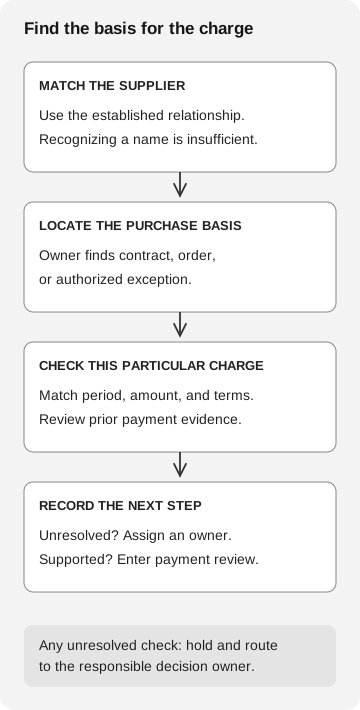
Find the basis for the charge
- Match the supplier
Use the established relationship. A recognized name is insufficient.
- Locate the purchase basis
The owner finds the contract, order, or authorized exception.
- Check this charge
Match period, amount, and terms; review prior payment evidence.
- Record the next step
If unresolved, assign an owner. If supported, enter payment review.
Any unresolved check stays with the responsible decision owner.
Compare three fictional invoices
The following examples are fictional.
Case A: a supported renewal. Alder Studio receives a renewal invoice from fictional Pine Scheduling. Its established supplier record matches. The business owner identifies the approved annual contract, and the invoice’s period and amount match that contract. Accounts payable finds no payment already covering the charge. The required approvals are recorded.
The invoice can enter normal payment review; the payment destination still needs verification. If a destination change appears, the supplier-change process still applies.
Case B: a directory listing nobody can substantiate. Another invoice claims to renew Alder Studio’s “priority industry listing.” It carries the correct address. The office manager remembers confirming the address on a call, but cannot identify an authorized purchase. Procurement has no matching agreement in its records.
Hold the invoice and ask procurement to find the agreement behind it. The missing record prevents routine approval, but an agreement could exist elsewhere. Record “purchase basis unresolved” and preserve the message and claimed reference. Do not resolve a possible legal dispute by editing an invoice note to say “scam.”
Case C: a real supplier, wrong period. Pine Scheduling submits another invoice, but its period matches the already recorded annual charge. The account and product are genuine. Accounts payable needs to resolve whether this is a duplicate, a correction, or another charge with a different basis.
This case tests a different weakness from impersonation. Recognizing a real supplier should not skip the period and payment-history checks. In the fictional outcome, accounts payable holds the second invoice and asks the established supplier contact for clarification through the approved process.
What if the invoice threatens a service cutoff?
A threatened cutoff creates a business-continuity question as well as a payment question. Give the service owner responsibility for checking the actual service account through the established portal or contact route. A phone number supplied only on the disputed invoice should not be the sole source of confirmation. Our callback guide explains how to record a contact’s provenance.
If the service owner confirms a genuine problem, use the organization’s authorized urgent-payment or exception procedure. Keep the basis for the charge and the exception approver visible. A process that cannot handle a legitimate deadline encourages people to work around it; a process that treats every deadline as approval makes the original review meaningless.
Avoid following a new payment link just to investigate. Staff can escalate the original message through the approved reporting route, while trained responders inspect suspicious content using their own procedures. The business owner can independently check the account without using that link.
Review the handoff, not just the first reader
Follow the review beyond the person who spots something odd. Ask accounts payable what goes to procurement. Ask procurement what evidence it requests. Ask the service owner what would establish the billed obligation. Then ask which role can approve an exception and what the final payment reviewer receives.
An escalation that says only “please confirm” loses the question at each handoff. A useful note in Case C is: “Invoice INV-C bills a period already covered by INV-A. No correction or additional-service reference is supplied. Accounts payable owns clarification before payment review.” It names the discrepancy and the work needed to resolve it.
If the team also relies on automatic duplicate-payment prevention, have the finance application owner verify that control separately. A reviewer catching Case C does not establish what the system would have done.
Record what happens next
Record whether the invoice can proceed to the next approval, is held for a specific question, or was rejected by an authorized owner and why. Use the organization’s accounting statuses to record that decision.
Case A should proceed, Case B needs procurement to establish the purchase basis, and Case C needs accounts payable to reconcile the billed period. A queue full of held invoices is not a successful review process. For organizations selling goods rather than paying a bill, the purchase-order shipping guide examines the opposite side of the transaction.