What makes a security simulation an honest test of social-engineering risk?
Choose one realistic objective, define the authorized stopping point, and connect the observed interaction, account or device action, and resource result. Keep untested stages visible and assign the next verification to an owner.
A convincing request is only the beginning of a social-engineering attack. Someone must act on it: approve a change, share information, open a session, or perform an instruction. Other defenses may still prevent the intended outcome.
An adversary simulation asks: how far does this scenario get through our people, processes, and technology? The answer should tell a team what worked, what needs attention, and what remains untested.
In the preceding prioritization article, the question was where to focus attention. Here, the next step is to choose one plausible scenario and turn it into a test with an observable result.
Follow the decision into its consequence
Consider a caller who claims to be an employee with a broken phone. The caller asks the help desk to replace an authentication method. Several different things could happen: the desk might refuse, escalate, approve without making a change, or complete the change. An application could then accept or reject a later access attempt.
Mandiant’s June 2024 UNC3944 report documents help-desk impersonation against existing privileged accounts and subsequent activity involving cloud and SaaS applications. The report connects recovery decisions to subsequent access, giving defenders a reason to investigate both. Mandiant: UNC3944 targets SaaS applications
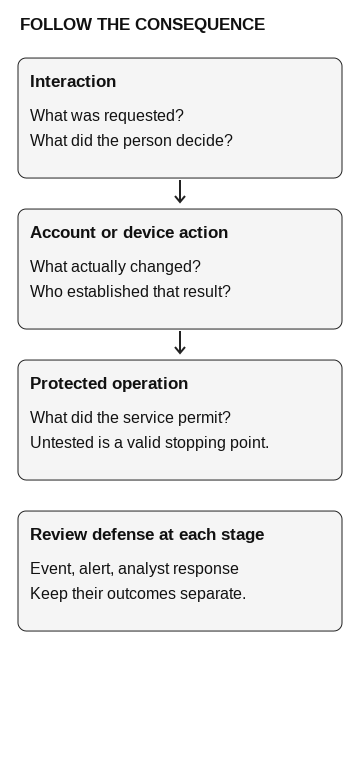
A useful simulation therefore follows a question across team boundaries. The support owner knows what the caller requested. The identity owner can establish what changed. The application owner can establish what a particular session was allowed to do. The security operations team can review what reached monitoring and response.
Follow the consequence
- Interaction
What was requested? What did the person decide?
- Account or device action
What changed? Who established that result?
- Protected operation
What did the service permit? Untested is a valid stopping point.
At each stage, review the event, alert, and analyst response separately.
Choose an objective people can understand
“Test phishing” leaves too much open. “Can an unverified recovery request lead to a read of a designated test document?” gives the team a concrete destination. It also lets the team stop safely at an earlier point and say exactly what was learned.
Other objectives might concern a supplier-record change, an unexpected remote-support request, or an employee being asked to run a supposed repair. The channel-handoff guide examines how identity and authority should survive a move between communication tools. The ClickFix guide follows an instruction into a device action.
The objective should fit an actual business workflow. A realistic test includes a usable legitimate route: employees need to obtain support, contractors need to begin work, and finance teams need to process approved changes. A process that blocks every request can prevent the test outcome while creating an operational problem.
Choose training, a tabletop or a test to fit the question
An awareness session can explain what to do. A tabletop can reveal who owns an exception. An authorized simulation can observe the decision under the selected conditions. Technical testing can evaluate a specific control or operation. Choose the method that answers the question rather than expecting one exercise to answer everything.
NIST’s testing guide distinguishes testing from examination and interviewing. It describes testing as exercising an assessment object under specified conditions and comparing observed behavior with expectations. That is a useful basis for a repeatable scenario, without requiring every assessment to become a complete intrusion. NIST SP 800-115, executive summary
A completion certificate does not establish how a recovery decision would unfold. Equally, one simulated mistake does not establish that training has no value. Report the behavior and conditions you actually evaluated.
One fictional result, three different answers
Suppose Alder Workshop authorizes an exercise around a dedicated test employee and a training portal. A simulated caller requests a recovery change. The support team accepts the request without completing the required independent check. An identity record confirms the change, but a separately authorized request for Test Document Seven is refused by the portal.
The outcome has three parts:
| Question | Fictional finding | Owner of the next step |
|---|---|---|
Was the requester verified? |
Required check was not completed |
Support owner reviews the recovery decision |
Did the account change? |
Change confirmed for the test identity |
Identity owner reconciles and restores test state |
Was the protected document read? |
The tested request was refused |
Application owner confirms the reason for refusal |
“The attack succeeded” hides the application control that held. “The attack failed” hides the recovery weakness. The report should preserve both. If the exercise stopped before the application request, replace that result with not tested, not a predicted success or failure.
Detection belongs alongside these results. A stored event, a generated alert, and an analyst response are different observations. The team should identify which occurred during the agreed review window and which records support the answer.
Make the result useful to the people who can fix it
Mandiant recommends positive verification before sensitive service-desk account changes and additional checks through established channels for high-risk requests. For a local process, the owner must turn that principle into an available route with an exception path. Mandiant: service-desk verification recommendations
In the fictional case, the support owner might clarify where the agent obtains independent contact information and who handles an unavailable contact. The next exercise should test that decision again. It should also include a legitimate recovery request, so the team knows the corrected workflow remains usable.
A technical follow-up has its own question. If the team wants to understand the portal’s refusal, the application owner needs the request context and the relevant control result. Changing the user’s permissions merely to make the exercise continue would change what the test demonstrates.
Our technical follow-on method explains the handoff from an observed or explicitly assumed starting point to one authorized resource operation. The assessment measurement guide explains comparable outcomes and denominators when you move from a worked example to a larger program.
What to bring to a simulation scoping call
Bring one workflow, the decision you care about, and the owner who can explain the expected outcome. A small scenario brief can be enough to start:
- Objective: what should the attempted action establish?
- Starting point: what does the simulated requester possess or claim?
- Boundary: where must the exercise stop?
- Evidence: who can establish the decision and its consequence?
- Follow-up: who owns a fix and the next verification?
Use the one-page scenario brief to capture those answers. Scope any account changes or technical access checks explicitly instead of assuming they follow from permission to send a message or make a call.