
Confirm the visitor through the established facilities or security process, then match the visit to an approved job, permitted locations, and a responsible host. A real contractor or a recognizable badge does not authorize every requested task.
For a service visit, reception needs to check both the visitor and the work order. Is this the expected person, doing the approved job, in the agreed area and time window?
A genuine service company can send a substitute, or a scheduled technician can ask to do extra work. Give reception a reachable facilities owner who can resolve those changes before access expands.
A plausible story is only the starting point
The UK’s National Protective Security Authority describes how hostile reconnaissance can involve learning about weak entry procedures or attempting entry using fraudulent identification. Its guidance emphasizes attentive security staff and document verification. Those observations support checking a visit through established records instead of accepting the visitor’s explanation alone. NPSA: robust visitor entry processes
Our public-information mapping article explains why knowing an employee’s name may not establish a relationship with them. Similarly, a work-order number supplied by a visitor is something to check against an internal record. It is not independent approval just because it looks specific.
Apply the same procedure to everyone in the relevant visitor category. An accent, appearance, or confident manner does not establish whether a job is authorized. The useful evidence is the approved visit and the confirmation provided by the responsible internal owner.
Give reception four questions it can answer
A practical visit record separates four questions:
- Person: Has the visitor’s identity and company relationship been checked through the site’s established process?
- Work: Does the facilities owner confirm this job, including any substitute or changed appointment?
- Place and time: Which areas and time window are approved?
- Host: Who is responsible for the visit, including any required escort and departure check?
The identity check should follow your organization’s policy, with only the personal information it requires. Do not add passport copies to a broadly shared training worksheet simply to make the exercise look thorough.
NPSA’s visitor recommendations for universities link visits to an internal host, limit access to the visit’s purpose, and call for access to be removed when the visit ends. That guidance is written for research institutions; the four questions above adapt its separation of identity, purpose, and access to an ordinary service appointment. NPSA: visitor security policy recommendations
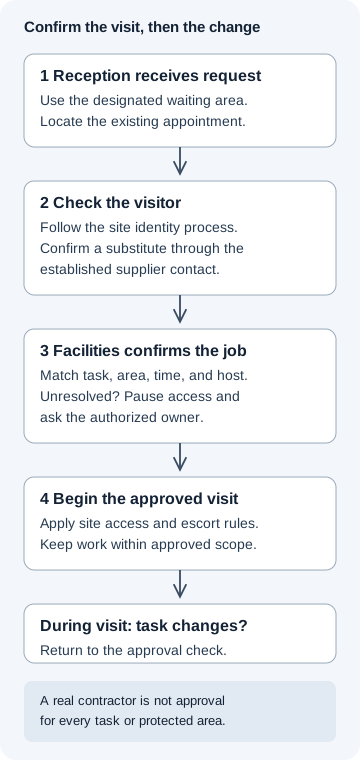
Confirm the visit, then the change
- Reception receives the request
Use the designated waiting area and locate the existing appointment.
- Check the visitor
Follow the site identity process. Confirm substitutions through the established supplier contact.
- Facilities confirms the job
Match task, area, time, and host. If unresolved, pause access and ask the authorized owner.
Only within the approved scope
- Begin the visit
Apply access and escort rules. A changed task returns to the approval check.
A real contractor is not approval for every task or protected area.
Confirm changes with facilities
A substitute technician or extra task needs confirmation against the existing appointment. Reception should contact the facilities owner through the internal directory. That owner can verify the substitute through the established supplier contact and decide whether the added work needs a separate request.
Record the approved person, job, areas, and host. Confirming a replacement technician does not automatically approve every task they propose. An unresolved difference can remain pending without accusing the visitor of malicious intent.
The visitor can wait in the site’s designated area while the question is resolved. Give reception a backup owner and a holding response: “I need our facilities owner to confirm the updated work before we start.” If no authorized owner is reachable, follow the site’s delay or rescheduling procedure. An employee should not have to invent permission to avoid inconveniencing a contractor.
For an actual emergency, use the established emergency procedure and responsible incident authority. Do not make reception negotiate emergency access from a generic blog checklist. A routine visitor process should also never require staff to physically confront or restrain someone; follow site safety instructions and contact trained security personnel when needed.
Make the handoff work during a busy shift
Check who covers facilities approval during absences, where reception finds the appointment record, and who supplies an escort when one is required. If staff cannot reach those people, the written procedure leaves them to negotiate at the door.
Our callback guide explains how to choose a trusted contact source. For an unsolicited device delivered to reception, use the separate USB intake workflow.