
What should an account recovery tabletop produce?
A decision record that connects each proposed action to evidence, authority, and an expected result. Use fictional injects to test handoffs, then assign up to three improvements with concrete retest conditions.
This exercise tests whether the help desk, identity team, incident responders, and application owner can act together when an employee disputes account recovery. It builds on the verification decision guide and the TAP enrollment example. Bring the current recovery procedure so participants can test the process they would actually follow.
The exercise takes 90 minutes. Every persona, record, and outcome below is fictional. It is discussion only: no live account changes, employee calls, or production queries. Record any proposed technical validation as follow-up work.
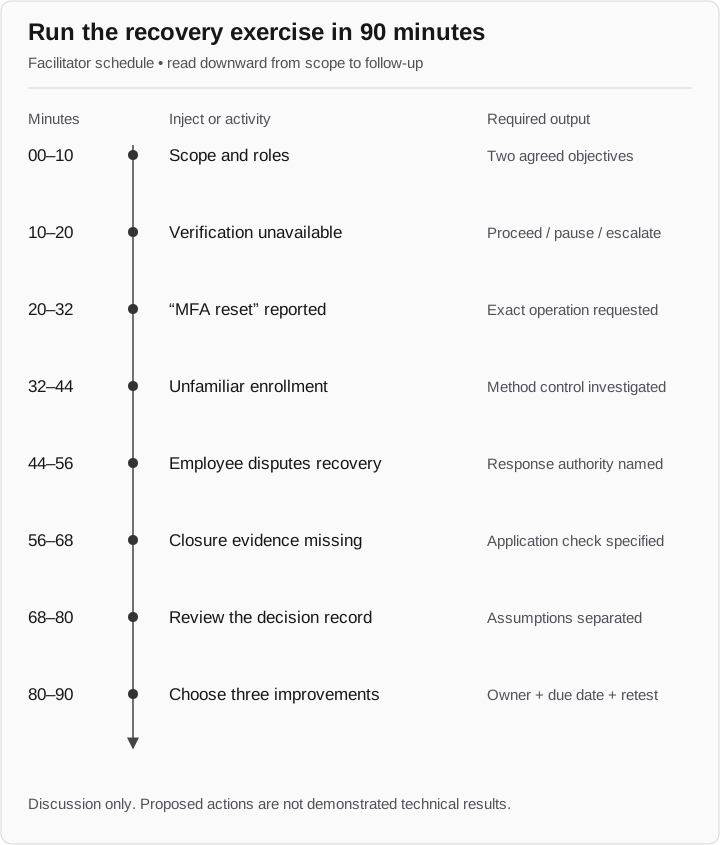
The 90-minute agenda

A 90-minute recovery exercise
- 00–10: scope and roles
Agree on two objectives.
- 10–20: verification unavailable
Decide whether to proceed, pause, or escalate.
- 20–32: “MFA reset” reported
Identify the exact operation.
- 32–44: unfamiliar enrollment
Investigate control of the method.
- 44–56: employee disputes recovery
Name the response authority.
- 56–68: closure evidence missing
Specify an application check.
- 68–80: review decisions
Separate evidence and assumptions.
- 80–90: choose improvements
Assign an owner, due date, and retest.
A discussion produces decisions, not demonstrated technical results.
| Minutes | Focus | Required output |
|---|---|---|
0–10 |
Scope and roles |
Two objectives and decision authority |
10–20 |
Verification route unavailable |
Proceed, pause, or escalate |
20–32 |
Ambiguous account change |
Exact administrative operation requested |
32–44 |
Unfamiliar enrollment |
Plan to establish method control |
44–56 |
Employee disputes recovery |
Response proposal and authority |
56–68 |
Closure evidence missing |
Application verification task |
68–80 |
Review the record |
Separate facts, assumptions, and proposals |
80–90 |
Choose improvements |
Up to three owners, dates, and retests |
Prepare a small evidence pack
Use the fictional employee Jordan Lee and a project portal. The first caller claims to be Jordan and reports a lost phone. Later, Jordan disputes the request. Give participants one inject at a time so that later facts do not justify earlier decisions retrospectively.
Prepare the recovery procedure and escalation directory with version dates. Add the five read-aloud prompts below to a facilitator-only sheet. Mark each prompt as exercise material. When someone requests information the case does not supply, answer “not provided” and record the request. Do not invent a favorable result.
NIST’s recovery guidance provides background on recovery methods and authenticator binding. Use your organization’s applicable assurance requirements when selecting the real procedure. A tabletop does not demonstrate compliance. NIST: account recovery
Decide who can approve each action
| Role | Decision or output |
|---|---|
Facilitator |
Releases injects and keeps the exercise within scope |
Recorder |
Retains decisions and the information available at that time |
Help desk |
Selects the approved verification and escalation route |
Identity engineer |
Identifies the account change and enrollment questions |
Incident lead |
Authorizes and coordinates the proposed response |
Application owner |
Defines the portal-session verification task |
Business representative |
Identifies a workable temporary arrangement for Jordan |
Keep a separate facilitator and recorder. Before the first inject, ask each participant which decision they can make and which requires someone else. If the decision maker is absent, record that gap. Nobody in the room inherits their authority.
Use a decision record throughout
| Field | Entry to capture |
|---|---|
Inject and time |
Information available when the decision was made |
Decision |
Exact action proposed or approved |
Basis |
Procedure section or supplied case record |
Assumption |
Unconfirmed fact the decision relies on |
Authority |
Role permitted to approve or perform the action |
Verification |
Observation that would establish the intended result |
Follow-up |
Unresolved question, receiving role, and checkpoint |
A useful entry names a task: “Identity engineer to identify the added method and reconcile it with Jordan’s approved replacement.” “Investigate account” is not enough to run a handoff. Keep earlier entries if later evidence changes the decision.
Minutes 0–10: establish the rules and expected outcome
Choose two objectives, such as handling an unavailable verification route and coordinating application-session review. Confirm discussion-only boundaries. If real credentials or a real incident appear, pause and route that issue through the normal operational process.
Minutes 10–20: inject one, the unavailable verification route
Read aloud: “The caller says Jordan’s phone is lost. The normal verification route is unavailable. The caller offers a new contact number.”
Require the help desk to identify its procedure branch and select proceed, pending, or escalation. Ask where the callback destination comes from and who may authorize a contact change. Before advancing, capture the receiving role and what Jordan would be told next. Watch for participants discussing how to reset the account before establishing authority to do it.
Minutes 20–32: inject two, an account change is reported
Read aloud: “An administrative summary says ‘MFA reset completed at 09:18.’ It gives no exact operation or verification reference.”
Ask the identity engineer to specify the record needed to distinguish a password reset, method change, or session action. Ask the help desk for the verification reference separately. The output is a precise evidence request, not a guess at what “reset” meant.
Minutes 32–44: inject three, an unfamiliar enrollment
Read aloud: “A method was added after recovery. Its controller is not established. Jordan’s manager cannot confirm that recovery was requested.”
Ask which record identifies the method, how the intended employee will be contacted through an approved route, and what would justify escalation. If removal is proposed, ask what it would change and which application questions would remain. The method’s presence alone does not establish a data read.
Minutes 44–56: inject four, the employee disputes recovery
Read aloud: “Reached through the approved contact process, Jordan denies requesting recovery and does not recognize the method. A project deadline is approaching.”
The incident lead must name the objects in the response proposal and the authority for each action. The business representative should identify the function Jordan needs to continue, rather than merely approve disruption. Capture the proposed temporary arrangement and who would authorize it.
Minutes 56–68: inject five, closure evidence is incomplete
Read aloud: “The unexpected method was removed. The portal-session state has not been checked, and no application operation result is available.”
Require a status update that distinguishes completed work from pending verification. Ask the application owner to name the protected operation, approved test context, expected result, and recipient of a failed check. The correct exercise output is a defined task; no technical result has been demonstrated in this room.
Minutes 68–80: compare decisions with evidence
Read the decision record in order. Mark each entry as supported by supplied evidence, a proposal awaiting evidence, contradicted, or not addressed. These are exercise labels, not platform statuses or a security score.
Ask where one function needed information another could not provide. A missing escalation destination, inaccessible enrollment record, and undefined application check are different problems. Keep them separate in the debrief.
Minutes 80–90: assign three improvements
Select at most three gaps that changed a decision. This illustrative action register shows the level of specificity needed:
| Exercise gap | Improvement | Retest condition |
|---|---|---|
No recipient for an unavailable verification route |
Approve a named escalation destination |
Repeated request reaches that role while the change remains pending |
“MFA reset” hides the operation |
Record the exact change and audit reference |
Reviewer can identify the operation without interviewing the original agent |
Portal closure cannot be verified |
Define an application-specific protected request |
Authorized test records the expected post-response result |
Add a named owner and due date to each selected action. Use the containment review when designing the last test. It separates application sessions, tokens, methods, devices, and grants so that one completed action does not close five different questions.
Check that the fix works
Confirm that an escalation reaches its owner, that an enrollment review identifies the disputed method, or that an application test establishes the post-response session state. Report that result alongside the original finding.
Facilitator files
The CSV files reproduce the tables above for editing. Fictional case entries are examples to replace, not collected evidence.