
Does a domain transfer lock prevent DNS changes?
A transfer lock such as clientTransferProhibited prevents transfer to another registrar. It does not, by itself, establish that changes to DNS records at the DNS provider are blocked. Review the specific operation, provider, permissions, and approval process.
The support ticket says the domain is locked. The request asks an administrator to replace its mail-routing records before the end of the day. Those two statements can both be true.
A company domain connects a business name to services people trust. Reviewing a change requires knowing which part of that arrangement is changing. The requested operation determines whose approval is needed and what to verify afterward.
Identify the registrar, registry, and DNS provider
The registrar manages your domain registration. The registry operates the registration database for a top-level domain, such as a particular domain suffix. A DNS provider hosts the records that tell clients how to find services. One supplier may perform more than one role, but the controls still protect different operations. ICANN distinguishes registrar-set and registry-set domain status codes. ICANN: domain status codes
A transfer moves the registration between registrars. A nameserver delegation identifies the servers responsible for answering for the domain. An edit inside the DNS zone can change a service destination without moving the registration. For example, an MX record identifies a mail server, while A and AAAA records supply IP addresses. Cloudflare: DNS record types
Before approving anything, translate “fix the domain” into a specific operation. Is the requester changing the registration contact, moving the registration, changing nameservers, or editing one record? Record the old and proposed values and the service owner who expects the change. If the requester cannot name the operation, there is not enough information to approve it.
Read the lock’s actual meaning
ICANN defines clientTransferProhibited as a direction to the registry to reject transfer requests to another registrar. It lists update prohibitions separately, including clientUpdateProhibited and serverUpdateProhibited. A label saying “locked” is therefore an incomplete control description. ICANN: transfer and update restrictions
A restriction on the domain object at the registry is not a universal permission policy for the DNS provider’s record editor. Ask the provider which operations the enabled protection covers. If someone can still edit a mail record through an authorized DNS account, a transfer restriction has not answered whether that edit is legitimate.
Cloudflare’s current Custom Domain Protection documentation illustrates a stronger, product-specific approval boundary. For eligible Enterprise customers, it describes registry locking where available and manual, out-of-band authentication for ownership or nameserver changes. That does not establish that every registrar offers the same workflow or that every DNS-record edit uses it. Cloudflare: Custom Domain Protection
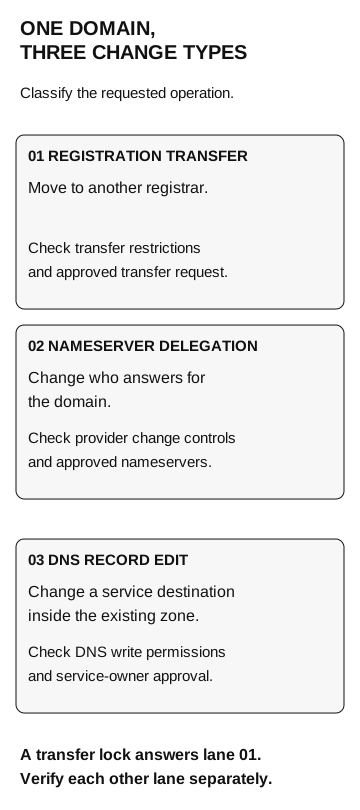
One domain, three change types
- Registration transfer
Moves the domain to another registrar. Check transfer restrictions and approval.
- Nameserver delegation
Changes who answers for the domain. Check provider controls and approved nameservers.
- DNS record edit
Changes a service destination within the existing zone. Check DNS write permissions and service-owner approval.
A transfer lock addresses the first change type. Verify the other two separately.
Why this belongs in a social-engineering program
An attacker may persuade an administrator to make the change for them. A message may claim that a vendor needs an urgent DNS correction, or that an unavailable administrator authorized a recovery request. The useful question is whether the recipient verifies that specific change with a trusted owner before using their access.
Mandiant’s January 2019 investigation documented manipulation of A and NS records in a DNS hijacking campaign. Its report describes how changed DNS answers could direct users to attacker-controlled infrastructure and support credential interception. It did not establish a single initial-access method for every victim. Mandiant: global DNS hijacking campaign
Keep that distinction in your own reporting. “The administrator approved an unverified change request” describes an observed human decision. “Traffic was redirected” needs technical evidence. “Credentials were stolen” needs further evidence again. A tabletop can test the first decision without claiming to demonstrate the later outcomes.
The callback contact-source guide applies here: a telephone number supplied in the disputed request is not an independent route to approval. Use the established service-owner record and provider contact process. For the related identity-system boundary, our federation trust article explains why a valid configuration can still represent an unauthorized business decision.
If the mail-routing change has already happened
Bring in the DNS and mail owners. Preserve the request and available change history, compare the deployed state with the approved configuration, and let the incident owner coordinate restoration and investigation.
A saved edit establishes a configuration action. An independently checked DNS answer establishes what that query returned at that observation point and time. Neither alone proves that every user received the answer or that mail reached an attacker. Restoration also does not establish that previously exposed secrets are safe.
The containment review provides a way to track those unresolved outcomes. Closing the DNS change and closing its consequences are separate decisions.
Keep recovery records reachable if domain services fail
A domain incident is a poor time to discover that nobody knows the registrar account owner. Maintain the registrar, DNS provider, internal service owners, backup approvers, emergency contact routes, and evidence-storage location as part of the service record.
ICANN’s recovery guidance recommends retaining evidence connecting the organization to its domain, such as registration/payment records and registrar correspondence. It also cautions that supporting documents may need corroboration. These records help a recovery request; they are not a promise of immediate restoration. ICANN: documentation for hijacked-domain recovery
As a practical resilience measure, make sure authorized responders can reach the packet if the affected domain’s mail or sign-in service is unavailable. Protect it as sensitive business information. Test access with the actual backup owner rather than assuming a shared-folder link is enough.
Review the control for the operation you need
A transfer restriction, a provider’s nameserver-change approval, and a DNS editor’s permissions answer different questions. Any technical validation should identify the exact operation and use a separately approved test domain with restoration steps and service-owner participation. A refused transfer says nothing by itself about whether an MX edit would succeed.
The service record should name the operation, approver, applicable control, and resulting state. A generic “domain locked” entry cannot answer those questions.